
Generative engine optimization (GEO): what gets a local business named by AI, and what's hype
By Hai Pham, founder of ATAVORA · 12 minute read
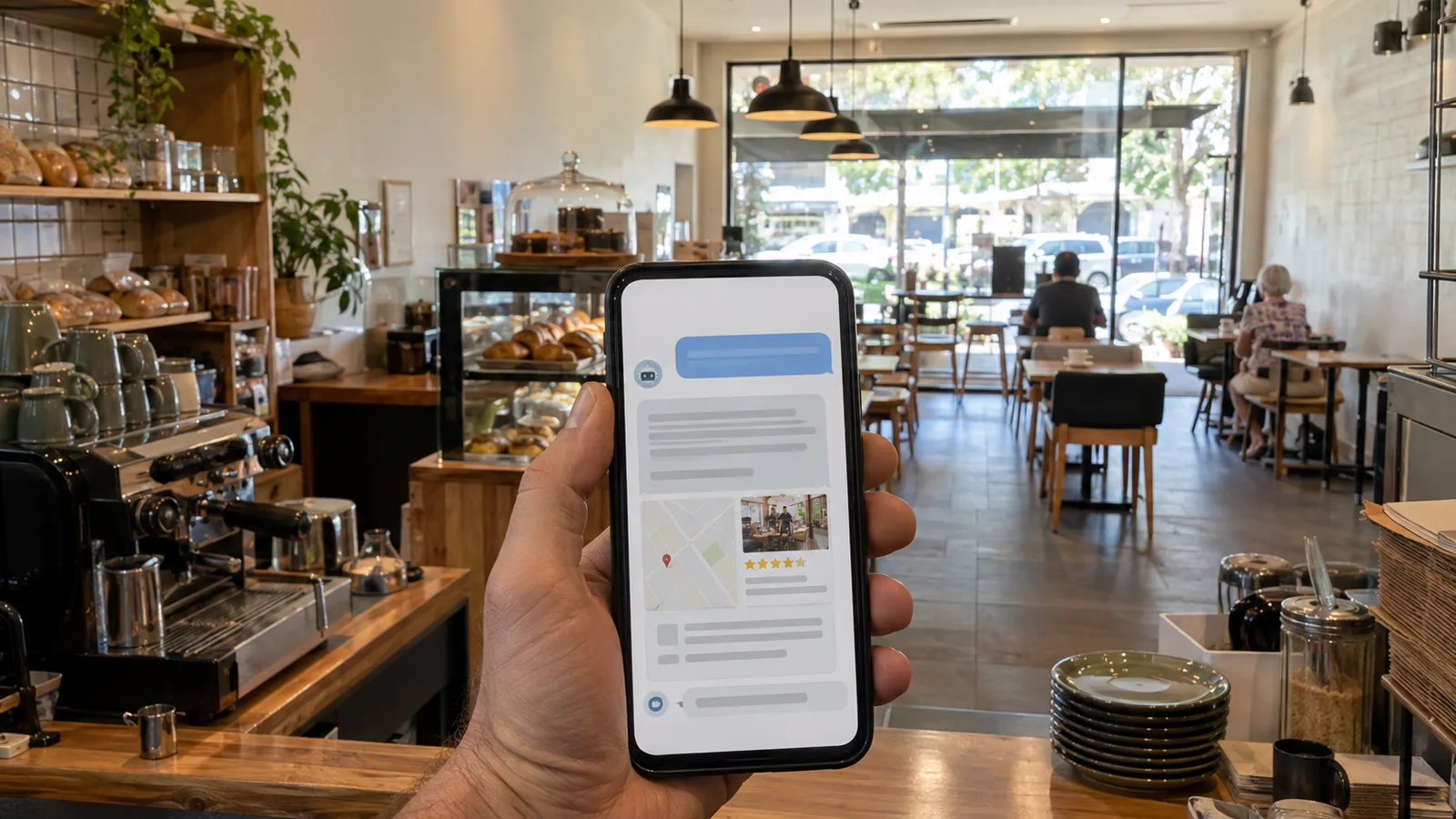
Generative engine optimisation (GEO) means working on how your business shows up in answers written by AI tools: ChatGPT, Perplexity, Gemini, and Google's AI Overviews and AI Mode. For a local business, the evidence so far points to familiar work, not a new trick: plenty of genuine Google reviews, an accurate Google Business Profile, consistent details across the web, and a website with clear facts. This guide shows what that evidence is, what it can't prove, and what to do first.
The one-minute version
- Google says there's nothing extra to do to appear in AI Overviews or AI Mode, and no special structured data is needed.
- For local businesses, reviews stand out. In a study of 10,000 local businesses, those named by both ChatGPT and Perplexity averaged 133.4 Google reviews; those named by neither averaged 10.7.
- AI answers are unstable. Asking the same question again gave the same businesses only 20 to 33% of the time across ChatGPT, AI Mode and AI Overviews. One check proves nothing.
- Some popular tactics have no evidence behind them: llms.txt files, special "AI schema", rewriting your pages "for AI", buying mentions.
- All of the studies are observational and most come from companies selling AI or SEO tools. They show what goes together, not what causes what.
- What to do first: fix your Google profile, build a steady review habit, make your details consistent, and put real facts (prices, areas, hours) on your service pages. Then measure with the same questions every month.
What is generative engine optimisation?
Generative engine optimisation is the practice of making your business easier for AI tools to find, understand and mention when they write an answer. "Generative" refers to the AI generating a written answer instead of showing a list of links.
You'll hear several names for overlapping ideas:
| Term | What people usually mean |
|---|---|
| Generative engine optimisation (GEO) | Showing up in AI-written answers generally |
| Answer engine optimisation (AEO) | Showing up as the direct answer to a question, in AI tools or in Google's answer boxes |
| AI SEO / LLM SEO | Marketing labels for the same work; LLM stands for "large language model", the technology behind ChatGPT and similar tools |
| AI Overview optimisation | Showing up in Google's AI summary at the top of search results |
The labels matter less than the question underneath: when someone asks an AI tool for a business like yours, does it name you, does it get your details right, and does it link to your website?
How an AI answer gets put together
When you ask ChatGPT, Perplexity or Google's AI a question that needs current information, the tool usually searches the web, reads some pages, and writes an answer from what it found.
For local questions, AI tools also lean heavily on business listings, especially Google Business Profile data, and on reviews. That's where the evidence below comes in.
Google AI Overviews SEO: what Google itself says
Google publishes guidance for site owners on its AI features. The key lines:
"There are no additional requirements to appear in AI Overviews or AI Mode, nor other special optimizations necessary."
"There's also no special schema.org structured data that you need to add."
Google Search Central, source
Google's list of things worth doing includes keeping your "Business Profile information up-to-date". On llms.txt, a file some agencies sell as an AI fix, Google has said its search ignores it.
In other words, for Google, AI Overviews SEO is ordinary SEO done properly. Google's statements say nothing about ChatGPT or Perplexity, though. For those, we have to rely on studies.
What studies of local businesses found
We read the studies we could find on local businesses and AI answers. None is a controlled experiment, and most were published by companies that sell AI visibility or SEO tools. Read them as "these things tend to go together", not as proof.
| Study | Sample | Main finding | Limit |
|---|---|---|---|
| Insites, July 2026 | 10,000 local businesses, ChatGPT and Perplexity | 40.88% had never been recommended by ChatGPT (68.79% for Perplexity). Named by both: 133.4 Google reviews on average; named by neither: 10.7 | Sells measurement; observational |
| BrightLocal, September 2026 | 200,085 searches, 1,300 locations | Same results on a repeat run only 20 to 33% of the time; ChatGPT named 4.1 businesses per answer on average, AI Overviews 2.5 | Sells local SEO tools |
| Search Atlas, January 2026 | 104,855 "near me" citations | Small positive links: Google profile score about +0.16, review count about +0.10, replied reviews about +0.11; all correlations between about -0.01 and +0.16 | Sells SEO software |
| Joel House, May 2026 | 2,729 businesses, 14 industries, LA, New York, Chicago, Sydney | 66% not named by any AI tool; Google review count r = 0.333, domain authority r = 0.337 | Author's company sells AI visibility services; "observational and does not establish causation" |
| Cloute, October 2026 | 64,441 AI answers | Named 83.7% of the time when the AI had opened the business's own site, against 16.2% when it hadn't | Sells services; notes the link may run the other way |
| SOCi (undated) | Not stated | ChatGPT got locations right 65.5% of the time, Perplexity 69.8%, Gemini 99.2% | Vendor, no date |
Three patterns repeat across them:
- Reviews. Review count shows up again and again, more than anything technical.
- An accurate profile. Insites found only 55.58% of ChatGPT's answers fully matched the business's real Google profile data. Wrong details on Google tend to spread.
- Being readable. Businesses whose own website the AI had opened were named far more often.
What has no evidence yet
These are sold widely. We couldn't find evidence that they help a local business get named, and Google has rejected some of them for its own search.
- llms.txt files. Google says its search ignores them. One SEO saw OpenAI's crawler request the file, but no study shows it leads to more mentions.
- Special "AI" structured data. Google says none is needed. Normal structured data for your business type, services and FAQ is still useful for normal search.
- Rewriting pages "for AI" or splitting them into chunks. No evidence for local businesses. Clear writing that answers real questions works for both people and AI.
- Bought or arranged mentions. Google says seeking inauthentic mentions "isn't as helpful as it might seem", and fake reviews or endorsements are illegal in Australia, the UK and the US.
Missing from everything we read: a controlled test on small businesses, where some get a change and a matched group doesn't. Until someone publishes one, anyone claiming a specific GEO tactic "works" is going further than the evidence.
Why one check tells you nothing
Ask ChatGPT "best plumber in [your town]" today and again tomorrow, and you may get different names. BrightLocal measured this at scale: repeat runs matched only 23% of the time on ChatGPT, 21% on AI Mode and 33% on AI Overviews, and a business that appeared once appeared again only about half the time.
So a screenshot of one answer, good or bad, isn't a measurement. A fixed set of questions, asked the same way every month, is.
How to rank in ChatGPT as a local business: 7 steps in order
"Rank" is the wrong word for AI tools, since there's no fixed list, but this is the order we'd work in, based on the evidence above.
1. Fix your Google Business Profile. Correct name, categories, services, hours (including public holidays), photos, and a Website button that goes to the right page. This is the data AI tools most often repeat. More: Google Business Profile management.
2. Build a steady review habit. Ask every customer, the same way, with a short link or a QR code. Reply to every review. Don't buy, write, filter or reward reviews: the ACCC in Australia, the FTC in the US and the UK's DMCC Act 2024 all prohibit fake reviews.
3. Make your details consistent. Same name, address and phone on your website, Google profile and the main directories in your country.
4. Put real facts on your service pages. Prices or price ranges, how long things take, areas you serve, what's included, how to book. AI tools can only repeat facts that exist somewhere.
5. Answer the follow-up questions. For each main service, list the 5 to 10 questions a customer asks next ("how long does it last", "do you do weekends", "how much for two") and answer them on the page.
6. Let AI tools read your site. Check that your robots.txt and any firewall don't block the AI search crawlers you want to be read by. Some sites block them by accident.
7. Measure, the same way, every month. See the next section.
How to measure it yourself in 30 minutes a month
- Write 10 to 20 questions your customers would actually ask: "best [service] near [suburb]", "[service] open Sunday [town]", "[your business name] reviews".
- Ask each one in ChatGPT, Perplexity, Gemini and Google (look for the AI Overview or AI Mode). Ask the important ones twice.
- Record the results in a table like this:
| Month | Question | Tool | Were you named? | Was your site linked? | Who else was named | Exact words used about you |
|---|---|---|---|---|---|---|
| yes / no | yes / no |
- Keep the same questions every month so you compare like with like.
- In Google Analytics 4, set up a channel for visits from AI tools (chatgpt.com, perplexity.ai and similar) so you can see whether those mentions bring visits, and what those visitors do.
The "exact words" column matters more than it looks. If an AI describes you with wrong hours or an old service, that's usually a sign the wrong detail is sitting somewhere online.
Self-check: 10 questions about your business
| # | Question | Yes / No |
|---|---|---|
| 1 | Do you own and can you log in to your Google Business Profile? | |
| 2 | Are your hours on Google correct, including the next public holiday? | |
| 3 | Does the Website button on your profile go to the right page? | |
| 4 | Have you asked every customer this month for a review, the same way? | |
| 5 | Have you replied to every review in the last 3 months? | |
| 6 | Are your name, address and phone identical on your website and Google? | |
| 7 | Does each main service have a page with a price or price range? | |
| 8 | Does each service page say which areas you cover and how to book? | |
| 9 | Have you checked your robots.txt doesn't block AI search crawlers? | |
| 10 | Do you have a fixed list of questions you check every month? |
Fewer than 7 "yes" answers: start with questions 1 to 5. They're free, and they're where the evidence is strongest.
What generative engine optimisation costs
Published prices we found on 18 October 2026, for small businesses:
| Country | Entry prices published | Note |
|---|---|---|
| Australia | AUD 390 to 1,250 a month (8 providers) | Some include it inside SEO packages |
| UK | £400 to £595 a month in the middle of the market; one-off audits £79 to £500 | Several UK agencies include it in SEO |
| US | USD 299 to 2,500 a month (7 providers) | One vendor report quotes USD 1,800 to 4,200 for local businesses, based on proposals rather than published prices |
Given the evidence, we don't think a local business needs a separate, premium GEO package. The work that goes with being named is local SEO work (see local SEO services). That's how we price it at ATAVORA: the first AI mention check is part of our free Leak Check; the monthly check is included in Local Visibility. Prices exclude GST/VAT. ATAVORA invoices from Vietnam. Business customers in Australia and the UK are not charged GST/VAT by us; your accountant can tell you if you need to account for it. US clients: we provide a W-8BEN-E.
| Free Leak Check | Local Visibility | Local Visibility Plus | |
|---|---|---|---|
| Price | Free | A$599 a month | A$999 a month |
| AI mention check | Included, one-off | 20 questions monthly, 4 tools | 20 questions monthly, 4 tools |
| Google profile managed | No | Yes, 4 posts a month | Yes, 4 posts a month |
| Review system and replies | No | Yes | Yes |
| Service pages | No | 1 improved a month | 2 new a month |
Details: AI SEO.
Questions about generative engine optimisation
Is generative engine optimisation different from SEO?
For Google, no: Google says appearing in AI Overviews and AI Mode needs nothing beyond normal good SEO. For ChatGPT and Perplexity there's no official guidance, but the studies point to the same foundations for local businesses: reviews, accurate listings and clear websites.
What's the difference between GEO and answer engine optimisation (AEO)?
In practice they overlap. GEO is the broader term for AI-written answers; AEO usually means being the direct answer to a question. The work for a local business is the same.
Can a small business really get recommended by ChatGPT?
Yes, many are, but none can control it. In one study of 10,000 local businesses, about 59% had been recommended by ChatGPT at least once. Answers change from run to run, so the goal is to be named more often over time.
Do I need an llms.txt file?
Not for Google, which says it ignores it. It doesn't hurt to have one, but we haven't seen evidence that it leads to more mentions.
How long does GEO take to work?
There's no reliable answer. Correcting wrong details on your Google profile can change what AI tools repeat once they re-read the source; building reviews takes months. That's why monthly measurement with fixed questions matters.
Should I block AI crawlers from my site?
That's a business decision. If you want AI tools to describe your services accurately, they need to be able to read your pages. If you'd rather they didn't use your content, you can block them, knowing you may be mentioned less.
If you're in the UK or the US, does anything differ?
The AI tools are the same, but answers are local, so measure with questions about your own town. Rules differ on reviews: in the UK, the DMCC Act 2024 bans fake reviews and hidden incentives and bans supplying them as a service; in the US, the FTC rule on consumer reviews (16 CFR Part 465) bans fake reviews and buying reviews conditioned on being positive. Prices for GEO work also differ: see the cost table above.
Want to know where you stand today?
Our free Leak Check is a one-page report built from public data: your Google profile, your reviews next to the businesses around you, where you show up on Maps, and where your profile's Website button leads. It also checks whether AI assistants mention your business, and covers the signals this guide talks about.